
How Transit Media Advertising Helps Brands Dominate Local Markets
Local markets aren’t won with one big billboard. They’re won by consistent visibility in the right areas. That’s where transit media advertising becomes powerful.
Instead of waiting for customers to pass one fixed location, transit formats move with the city. Buses, cabs, auto rickshaws — they travel through residential pockets, office corridors, school zones, shopping belts and high-traffic junctions every single day. And that movement changes how brands build dominance
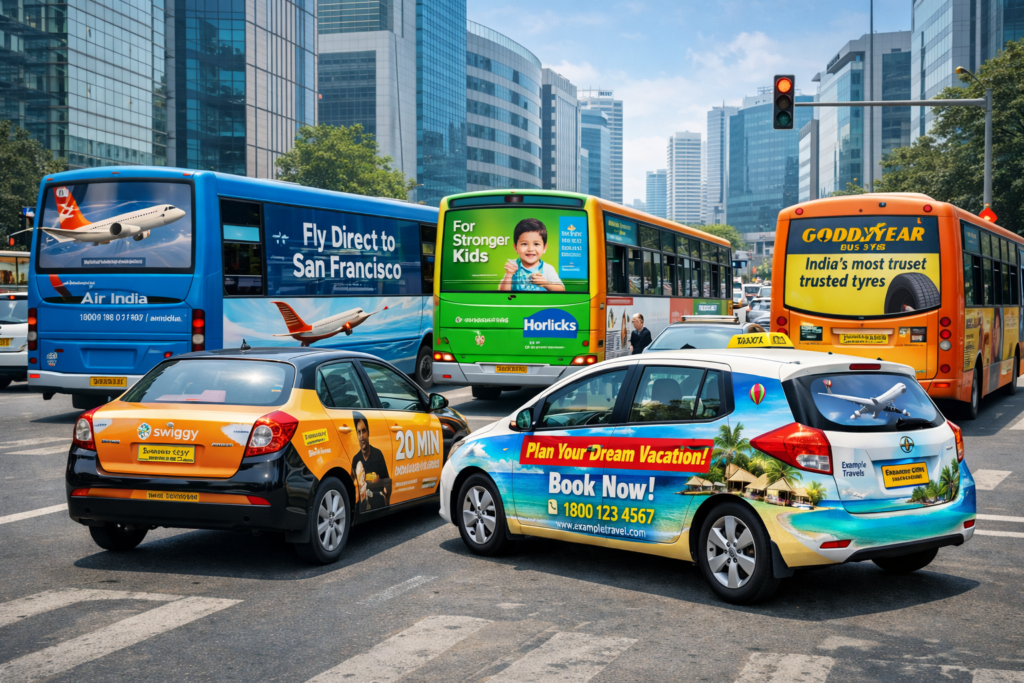
Movement-Based Visibility Creates Local Presence
A static hoarding gives visibility at one point. Transit gives visibility across multiple touchpoints. When a branded bus or cab moves through different neighborhoods in a day, it doesn’t just create impressions it creates familiarity in multiple micro-markets.
For growing brands trying to build strong recall in a specific city, that movement is not random exposure. It’s structured visibility. In cities like Mumbai, Bangalore, Hyderabad or Delhi, traffic congestion actually works in your favor. Slower movement means longer dwell time. Longer dwell time means stronger recall. That’s the practical advantage of transit formats.
Route-Based Targeting Is the Real Game
Many brands waste budget by spreading campaigns too widely.
But transit campaigns can be planned route-wise.
You can choose:
- IT corridors
- Premium business districts
- Dense residential areas
- Retail-heavy markets
- Airport routes
This is where transit media advertising becomes strategic instead of generic. Instead of targeting “the whole city,” brands can dominate specific zones repeatedly.
For example:
- A real estate brand can focus on residential belts.
- A fintech company can target corporate corridors.
- A coaching institute can prioritize school and college routes.
When route planning aligns with audience movement, visibility turns into influence.
Repetition Is What Builds Market Authority
Local domination doesn’t come from one exposure. It comes from repetition. Transit vehicles follow fixed routes daily. The same audience clusters see them again and again at signals, near offices, outside markets.
Over time, that repetition builds psychological comfort. People start feeling:
“This brand is everywhere.” And when that perception forms, trust follows. That’s why transit campaigns often outperform isolated premium hoardings in terms of recall.
Cost Efficiency Compared to Static Hoardings
Large-format hoardings are premium assets. But they come at premium prices and remain fixed in one location. Transit formats, on the other hand, distribute impressions across multiple zones without multiplying cost proportionally. For emerging and expanding brands, this makes a major difference.
Instead of investing heavily in one landmark location, brands can create city-wide movement within selected target routes. Planned correctly, transit media advertising delivers stronger cost-per-impression compared to single-location static media.
Why Growing Brands Prefer Transit Formats
Established national brands use transit for mass reinforcement. But growing brands benefit even more.
Because they need:
- Area-wise penetration
- Strong local recall
- Consistent presence
- Reinforcement of digital campaigns
Transit supports all four. When someone sees your digital ad and later notices your branding on a bus or cab in their area, it reinforces memory. Reinforcement builds brand scale perception even before scale actually exists That perception is powerful in competitive local markets.
The Strategic Edge
Transit media is not just about vehicles moving. It’s about structured route planning, audience mapping, and repeated exposure cycles. When executed properly, it creates the feeling that the brand owns certain zones of the city. That’s how local dominance begins.
Frequently Asked Questions
Transit media works because it moves through multiple high-traffic areas daily. Instead of staying in one fixed location, vehicles create repeated exposure across residential, commercial, and corporate zones — which strengthens brand recall.
It depends on the objective. Static hoardings provide strong visibility at one landmark location, while transit media distributes exposure across multiple routes. For brands targeting specific neighborhoods or local markets, transit often delivers wider area penetration.
Yes. Route selection is one of the biggest advantages of transit formats. Brands can choose corporate corridors, residential belts, airport routes, school zones, or retail markets based on their target audience.
Since repetition builds recall, most campaigns run for at least 30 days. Longer durations improve familiarity and strengthen local brand presence.
Emerging brands, real estate projects, fintech companies, edtech platforms, retail chains, and app-based services benefit significantly — especially when targeting city-specific audiences.
Conclusion
In competitive urban markets, visibility alone isn’t enough. Consistency wins. Route precision wins. Repetition wins. Transit formats combine all three. When planned strategically, transit media advertising becomes more than outdoor media — it becomes a market penetration tool.
For brands looking to dominate specific local markets instead of just “being visible,” transit remains one of the most practical and scalable formats available.
👉 Also Check Out Our Related Blogs
📍 Ghaziabad
http://1️⃣ https://adblinkmedia.com/bus-advertising-ghaziabad/ 2️⃣ https://adblinkmedia.com/cab-branding-in-ghaziabad/ 3️⃣ https://adblinkmedia.com/top-hoarding-locations-in-ghaziabad/ 4️⃣ https://adblinkmedia.com/mobile-van-advertising-ghaziabad/
📍 Noida
http://5️⃣ https://adblinkmedia.com/why-bus-branding-in-noida/ http://6️⃣ https://adblinkmedia.com/bus-branding-outdoor-advertising-noida/
📍 Lucknowhttp://7️⃣ https://adblinkmedia.com/bus-branding-boost-business-lucknow/ https://adblinkmedia.com/top-hoardings-outdoor-advertising-lucknow/
Bus Advertising in Lucknow: A Simple Way for Brands to Stay Visible – adblinkmedia.com
BLOG
https://adblinkmedia.com/cab-advertising-bangalore-tech-office-corridors/
https://adblinkmedia.com/auto-rickshaw-advertising-mumbai-everyday-life/
https://adblinkmedia.com/mumbai-bus-advertising-impact/
https://adblinkmedia.com/bus-advertising-chennai-everyday-commute/
https://adblinkmedia.com/train-advertising-bangalore-daily-travellers/
https://adblinkmedia.com/bus-advertising-bangalore-daily-commuters/
https://adblinkmedia.com/auto-rickshaw-advertising-bangalore-local-areas/
https://adblinkmedia.com/best-bus-advertising-agencies-in-mumbai/