
Static vs Moving Outdoor Media: What Works Better?
Brands today don’t just ask whether to invest in outdoor. They ask what format delivers stronger results.
When comparing static billboards and moving transit formats, the real debate inside outdoor advertising in India is no longer about visibility — it’s about strategy.
So what actually works better?
Let’s break it down realistically.
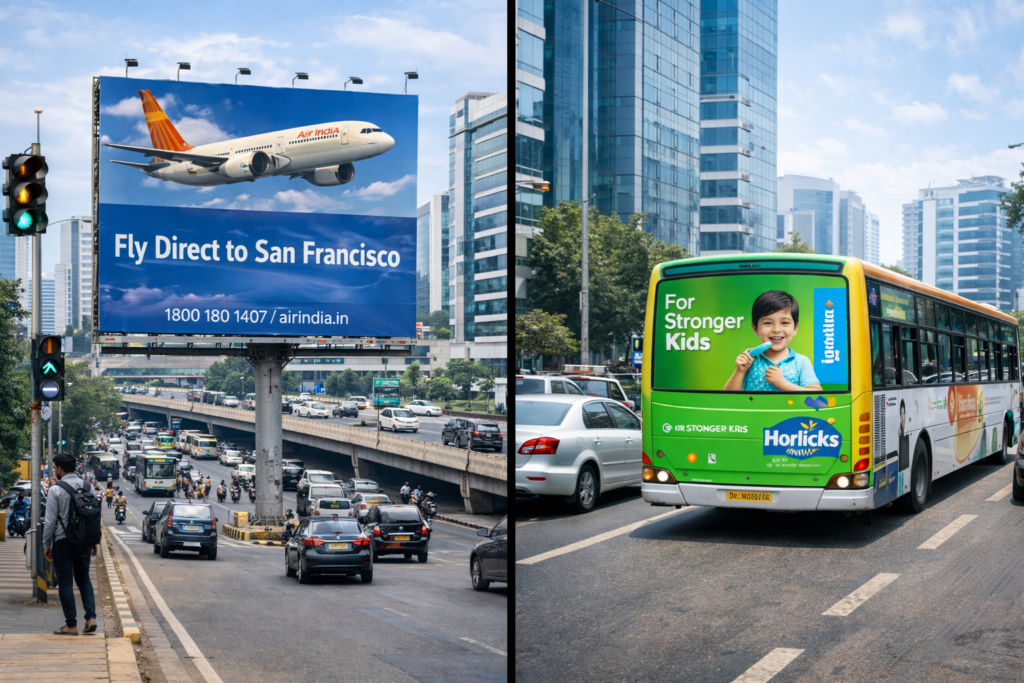
What Static Outdoor Media Does Best
Static formats include:
- Hoardings
- Billboards
- Unipoles
- Wall wraps
- Fixed digital screens
They stay in one location and build dominance around that specific spot.
Where Static Wins
Landmark Authority
A premium hoarding at a high-traffic junction can create instant brand stature. For luxury housing, large launches, or high-value positioning, static media gives scale perception.
Strong Visual Impact
Large formats allow bold creative execution. If your message is simple and visually powerful, static media delivers sharp first impressions.
But static performance depends heavily on location quality. If the site isn’t high-traffic or premium, the impact drops quickly.
Movement Creates Multiple Touchpoints
A bus doesn’t stay at one signal.
It moves through:
- Residential clusters
- Corporate corridors
- Retail markets
- School belts
- Traffic-heavy junctions
In one operational day.
That means one vehicle can generate impressions across multiple micro-markets.
Instead of depending on one strong spot, brands gain distributed visibility.
Repetition vs Positioning
Static media builds positioning.
Moving media builds repetition.
Vehicles follow fixed routes daily, meaning the same audience groups see them repeatedly throughout the week.
And in advertising psychology, repetition increases familiarity.
Familiar brands feel safer.
Safer brands get chosen more often.
This repetition advantage is one reason transit formats are gaining traction within outdoor advertising in India, especially for emerging brands.
Cost Perspective
Premium hoardings in metro cities come at premium rates.
You’re paying for:
- Location exclusivity
- Landmark value
- High single-point impressions
Moving media distributes impressions across wider areas without concentrating the entire budget in one spot.
For growing brands trying to increase area penetration instead of prestige positioning, this distribution often delivers stronger practical returns.
When Static Works Better
Choose static if:
- You want to dominate one key junction
- You’re launching a high-value project
- Brand prestige is your priority
- Visual scale matters most
Static builds authority in a defined location
When Moving Works Better
Choose moving formats if:
- You want repeated exposure
- You need route-based targeting
- You’re supporting digital campaigns
- You want visibility across multiple neighborhoods
Moving media builds presence across daily city movement.
Frequently Asked Questions
Static outdoor media includes fixed formats like hoardings and billboards placed in one location. Moving outdoor media includes transit formats like buses, cabs, and auto branding that travel across different areas of a city.
Moving outdoor media is often more effective for local penetration because it covers multiple neighborhoods and creates repeated exposure along fixed routes.
Yes. Static hoardings in landmark locations are ideal for building brand stature and premium perception, especially for real estate, luxury, and large-scale launches.
In many cases, yes. Transit formats distribute impressions across several areas instead of concentrating visibility in one location, which can improve cost-per-impression for growing brands.
For maximum impact, many brands use both. Static builds strong visual authority in one location, while moving media reinforces recall through repetition across different routes.
Conclusion
There’s no universal winner. Static media builds stature. Moving media builds spread and repetition. In many strong campaigns, brands combine both.
One builds perception.
The other builds familiarity.
And in competitive markets, familiarity plus perception creates dominance.
👉 Also Check Out Our Related Blogs
📍 Ghaziabad
http://1️⃣ https://adblinkmedia.com/bus-advertising-ghaziabad/ 2️⃣ https://adblinkmedia.com/cab-branding-in-ghaziabad/ 3️⃣ https://adblinkmedia.com/top-hoarding-locations-in-ghaziabad/ 4️⃣ https://adblinkmedia.com/mobile-van-advertising-ghaziabad/
📍 Noida
http://5️⃣ https://adblinkmedia.com/why-bus-branding-in-noida/ http://6️⃣ https://adblinkmedia.com/bus-branding-outdoor-advertising-noida/
📍 Lucknowhttp://7️⃣ https://adblinkmedia.com/bus-branding-boost-business-lucknow/ https://adblinkmedia.com/top-hoardings-outdoor-advertising-lucknow/
Bus Advertising in Lucknow: A Simple Way for Brands to Stay Visible – adblinkmedia.com
BLOG
https://adblinkmedia.com/cab-advertising-bangalore-tech-office-corridors/
https://adblinkmedia.com/auto-rickshaw-advertising-mumbai-everyday-life/
https://adblinkmedia.com/mumbai-bus-advertising-impact/
https://adblinkmedia.com/bus-advertising-chennai-everyday-commute/
https://adblinkmedia.com/train-advertising-bangalore-daily-travellers/
https://adblinkmedia.com/bus-advertising-bangalore-daily-commuters/
https://adblinkmedia.com/auto-rickshaw-advertising-bangalore-local-areas/
https://adblinkmedia.com/best-bus-advertising-agencies-in-mumbai/