
Mumbai Train Advertising: Local Train, Platforms & Metro Ad Opportunities
If you’ve ever squeezed into a packed Virar fast during peak hours or waited at Dadar station while three locals passed before you could even think about boarding, you already know what I’m about to say. Mumbai runs on its trains. The city doesn’t just use them—it depends on them. And that’s exactly why Train Advertising in Mumbai has become one of those media formats that quietly delivers massive reach while everyone else is busy fighting over digital ad space.
Mumbai Local Train Ads aren’t some outdated branding tactic your agency suggests when they’ve run out of ideas. They’re a legitimate, high-impact format that puts your brand in front of millions—and I mean literally millions—of commuters every single day. Add Mumbai Metro Advertising into the mix, and you’ve suddenly got access to the newer, slightly more upscale transit crowd as well. Then there’s Railway Station Ads Mumbai, covering everything from platform branding to footbridge wraps to digital screens at major junctions like Churchgate, Bandra, Andheri, and Thane. Together, this is what Transit Media Mumbai looks like in 2025, and if you’re not at least considering it, you’re leaving reach on the table.
Let me break down why this works, where it works best, and how to actually do it right without wasting money on formats that don’t fit your brand.
Why Train Advertising in Mumbai Actually Makes Sense
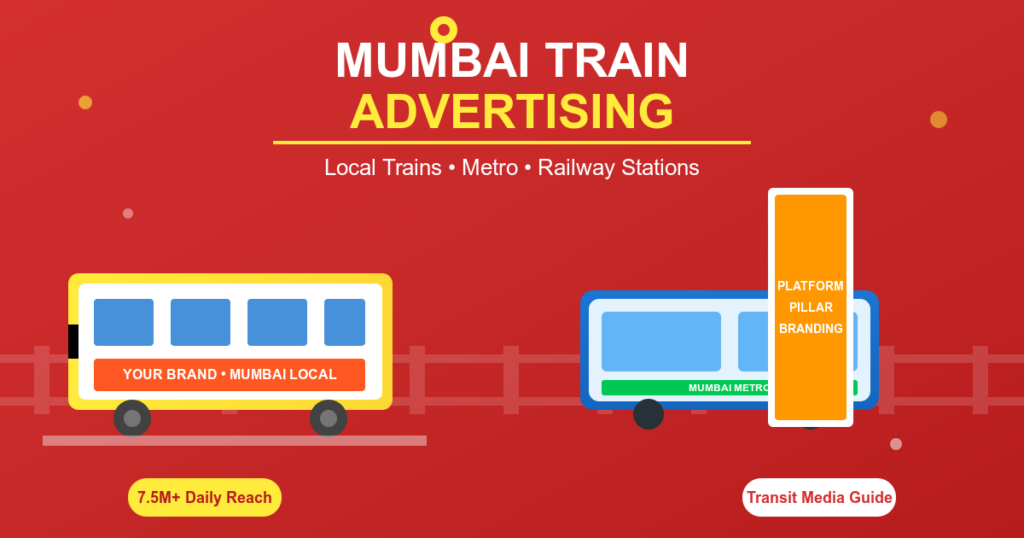
Everyone will hit you with the stats. Over 7.5 million people use Mumbai’s local trains daily. The metro adds another few lakhs. Dwell time at major stations can go up to 15–20 minutes during delays. All true, all impressive.
But here’s what the numbers don’t tell you—Mumbai’s train commuters are mentally available. They’re standing on a platform with nothing to do. They’re sitting in a coach staring at the ceiling or the ads above the windows because their phone battery is dying and the network is terrible inside tunnels anyway. They’re walking across a footbridge at Dadar or Kurla, and your brand is right there at eye level. That’s passive attention, but it’s real attention, and in a world where everyone’s scrolling past your Instagram ad in 0.3 seconds, that attention is valuable.
I worked with a mutual fund company once—mid-tier brand, not a household name. They ran interior coach ads on the Central and Western lines for about four months. Their call center started getting inquiries from people who mentioned seeing the ad “on the train.” Not online. Not on TV. On the train. And these weren’t random inquiries—they were serious, qualified leads because the ad had been sitting in front of them for 45 minutes while they commuted from Kalyan to CST. That’s the kind of slow-burn effectiveness you get with Mumbai Local Train Ads that you just don’t get with a banner ad that disappears in three seconds.
Types of Train Advertising Formats in Mumbai
Train advertising isn’t one-size-fits-all, and honestly, picking the wrong format is where most campaigns go wrong. Let me walk you through what’s available and what actually works.
Platform Branding
This includes platform back panels, pillar wraps, and those long vinyl sheets that run along the platform edge. Major stations like Churchgate, Andheri, Borivali, Thane, and Dadar offer premium platform spots that see insane footfall.
Platform ads work best when they’re bold and simple. People aren’t stopping to read paragraphs. They’re rushing to catch trains, dodging crowds, checking which coach to board. Your job is to make them remember one thing—your brand name, your tagline, or a strong visual. I’ve seen beautifully designed ads with five selling points and a long disclaimer—nobody reads them. But a clean visual with a memorable tagline? That sticks.
Footbridge and Skywalk Branding
Every commuter entering or exiting a major station uses the footbridge or skywalk. It’s a forced interaction, and because people are moving slower on stairs or ramps, they actually absorb more information here than on platforms.
I’ve noticed healthcare brands and educational institutions absolutely dominate FOB branding at stations like Ghatkopar, Mulund, Bandra. Makes sense—these are residential catchment areas where families and students pass through daily. The repeated exposure builds familiarity, and familiarity eventually drives consideration when someone actually needs that service.
Interior Coach Panels
This is where you get long-duration exposure. Someone traveling from Virar to Churchgate is stuck in that coach for over an hour. They’ll see your interior panel ad multiple times, whether they want to or not.
Interior coach ads work brilliantly for brands that need time to explain value—insurance, financial services, online education, healthcare packages. You can use slightly more detailed messaging here compared to platform ads, but don’t go overboard. A clear headline, supporting copy, and a strong CTA (phone number, website, QR code) is the formula.
One thing though—Western Railway and Central Railway have different approval processes and different audience profiles. Western line skews slightly more upscale (Bandra, Andheri, Borivali corridors), while the Central line reaches deeper into the suburbs and the Thane district. Your messaging should reflect who’s actually seeing it.
Exterior Train Wraps
Full train wraps are high-impact and impossible to miss. When a fully branded local pulls into CST or Dadar, hundreds of people on the platform see it at once. It’s a moving billboard that travels across the city multiple times a day.
But let’s be real—exterior wraps are expensive, require approvals from railway authorities, and the maintenance is a headache. I’ve seen train wraps that looked stunning on launch day and looked completely trashed three weeks later because nobody was monitoring the upkeep. Dust, rain, wear-and-tear—if you’re not maintaining it, you’re damaging your brand image instead of building it.
That said, when executed properly with the right maintenance plan, train wraps are unbeatable for mass reach. Real estate brands, FMCG majors, telecom companies, and big retail chains use them during key campaign periods because the visibility is just insane.
Digital LED Screens
CST, Dadar, Andheri, Bandra, and a few other major stations now have digital screens at entry/exit points and on platforms. These are expensive compared to static formats, but they give you flexibility—you can change creatives quickly, run multiple messages, and movement on a screen just grabs attention better.
Digital works well for short-term campaigns—festive sales, movie releases, product launches, event promotions. If you’re building long-term brand presence, static might actually be more cost-effective because it’s there 24/7 becoming part of the station environment.
Mumbai Metro Advertising: The Urban Layer That Completes Transit Media
Mumbai Metro Advertising is a slightly different beast compared to local train advertising, and you need to approach it differently.
The metro audience is newer, slightly more upscale, and includes a lot of first-time transit users who previously relied on cabs or personal vehicles. Metro stations like Versova, Ghatkopar, Andheri East, Aarey, Bandra Kurla Complex attract office-goers, IT professionals, students from premium colleges, and families visiting malls or residential areas.
Metro branding is cleaner, more controlled, and tends to attract premium categories—fintech apps, luxury real estate, international schools, consumer electronics, wellness brands. The stations are air-conditioned, less chaotic, and people spend more time reading and noticing things while waiting.
I’ve seen tech startups, coaching institutes for competitive exams, and even co-working spaces do really well with metro branding because the audience profile matches. Someone taking the metro from Ghatkopar to BKC for work is exactly the kind of person who might be interested in premium services.
But here’s the thing—metro and local trains aren’t competitors in the transit media space. They’re complementary. A lot of commuters use both. Someone might take the metro to Ghatkopar and then switch to a local train to go further into the suburbs. If your brand is visible in both spaces, the recall is way stronger than relying on just one format.
Best Locations for Railway Station Ads Mumbai
Not all stations are created equal, and not all stations make sense for every brand. Here’s where you should actually be focusing:
Western Line: Churchgate, Marine Lines, Charni Road, Dadar, Bandra, Andheri, Borivali, Mira Road, Virar. High footfall, mixed audience, good for consumer brands, real estate, entertainment, healthcare.
Central Line: CST, Matunga, Kurla, Ghatkopar, Mulund, Thane, Dombivli, Kalyan. Covers suburban belt, huge daily commuter volume, works well for mass-market brands, education, financial services.
Harbour Line: CST, Wadala, Kurla, Vashi, Belapur, Panvel. Connects Mumbai to Navi Mumbai, good for real estate targeting the MMR region, logistics, manufacturing-related branding.
Metro Stations: Versova, Andheri, Ghatkopar, Aarey, BKC, Marol Naka. Premium audience, works for upscale brands, tech, finance, premium education, luxury retail.
If you’re running a campaign with limited budget, don’t spread yourself thin across all lines. Pick the one or two lines where your target audience actually commutes, and dominate those stations instead.
Who Should Be Using Transit Media Mumbai?
Real estate developers—Mumbai is obsessed with property. Locals carry lakhs of flyers about new projects. Train branding gives you visibility among people actively looking or planning to buy.
Educational institutions and coaching centers—Students are a massive chunk of the local train audience. If you’re an engineering college, MBA institute, or competitive exam coaching center, train advertising is almost mandatory.
Healthcare and hospitals—Families travel across Mumbai for specialized treatments. A multi-location hospital chain or a diagnostic lab benefits hugely from railway station visibility.
FMCG and consumer goods—Snacks, beverages, personal care, mobile phones, DTH services. These need mass reach, and local trains deliver exactly that.
Financial services—Insurance, mutual funds, loans, credit cards. The commuter audience includes salaried professionals who are the target demographic for most financial products.
Entertainment and OTT platforms—Movie releases, web series launches, streaming service promotions. Transit media creates buzz and recall at scale.
Common Mistakes Brands Make (and How to Avoid Them)
1: Using the same creative everywhere. A platform ad and an interior coach ad serve different purposes. Platform ads need to be instant and bold. Coach ads can afford slightly more detail. Tailor your creatives accordingly.
2: Ignoring maintenance. If you’re doing exterior wraps or even platform branding, have a monitoring and maintenance plan. A dirty, peeling ad is worse than no ad at all.
3: Overcomplicating the message. Transit advertising is not the place for a manifesto. One clear message, one strong visual, one CTA. That’s it.
4: Picking locations randomly. Don’t just go for “high footfall.” Go for high footfall of your target audience. A premium wellness brand has no business advertising at Virar station, but would do really well at Bandra or Andheri.
5: Running campaigns that are too short. Transit media is a frequency game. You need at least 2–3 months for people to notice, remember, and act. A two-week campaign is basically invisible.
Real-Life Example: How a Mid-Tier Brand Nailed Train Advertising
A friend’s ed-tech startup was struggling with digital ad fatigue. Their CAC was climbing, and Facebook ads weren’t converting like they used to. They decided to test Mumbai Local Train Ads on the Central line—interior coach panels and platform branding at Thane, Dombivli, and Kalyan stations.
Three months in, their website traffic from Mumbai suburbs spiked. More importantly, the quality of leads improved. These weren’t random clicks—they were people who’d seen the ad daily during their commute, checked out the website later, and then signed up for demo classes. The startup ended up extending the campaign for another six months and credited train advertising with a significant chunk of their enrollments from MMR region.
That’s the thing about Transit Media Mumbai—it doesn’t give you instant results, but when it works, it works at scale and the leads are warmer because the brand has already built familiarity.
Wrapping It Up: Is Train Advertising in Mumbai Worth It?
If your brand needs mass reach, repeated exposure, and regional penetration across Mumbai and MMR, then yes—Train Advertising in Mumbai is absolutely worth considering. It’s not the sexiest media format, it won’t give you viral moments, and you can’t track it with a pixel. But it does something digital can’t—it puts your brand in physical spaces where millions of real people spend real, uninterrupted time every single day.
Mumbai Local Train Ads, Railway Station Ads Mumbai, and Mumbai Metro Advertising aren’t competing with your digital campaigns. They’re supporting them. Someone sees your train ad in the morning, searches for your brand on their phone during lunch, sees your retargeting ad in the evening, and converts over the weekend. That’s how modern marketing works—layered, integrated, multi-touchpoint.
Just make sure you work with agencies or partners who actually understand railway advertising—the approvals, the execution quality, the station-wise audience behavior, and most importantly, the maintenance. Because in transit media, execution makes or breaks everything.
Conclusion
Look, I get it. Train advertising doesn’t have the glamour of a viral Instagram campaign or the instant gratification of Google Ads where you can track every click. But here’s what it does have—unmatched scale, forced attention, and the kind of repeated brand exposure that actually builds recall in people’s minds.
Train Advertising in Mumbai works because it meets people where they already are, doing something they do every single day. It’s not interrupting their experience; it’s becoming part of their daily journey. And in a city where over 7.5 million people rely on local trains and lakhs more are shifting to the metro, that’s an opportunity you can’t afford to ignore.
The brands that succeed with Transit Media Mumbai are the ones that understand it’s not about quick wins. It’s about consistency, smart location selection, clean execution, and messaging that actually resonates with commuters. Whether you choose Mumbai Local Train Ads for mass reach, Railway Station Ads Mumbai for high-frequency visibility, or Mumbai Metro Advertising for a premium audience—the format works when you respect what it does best.